The Story
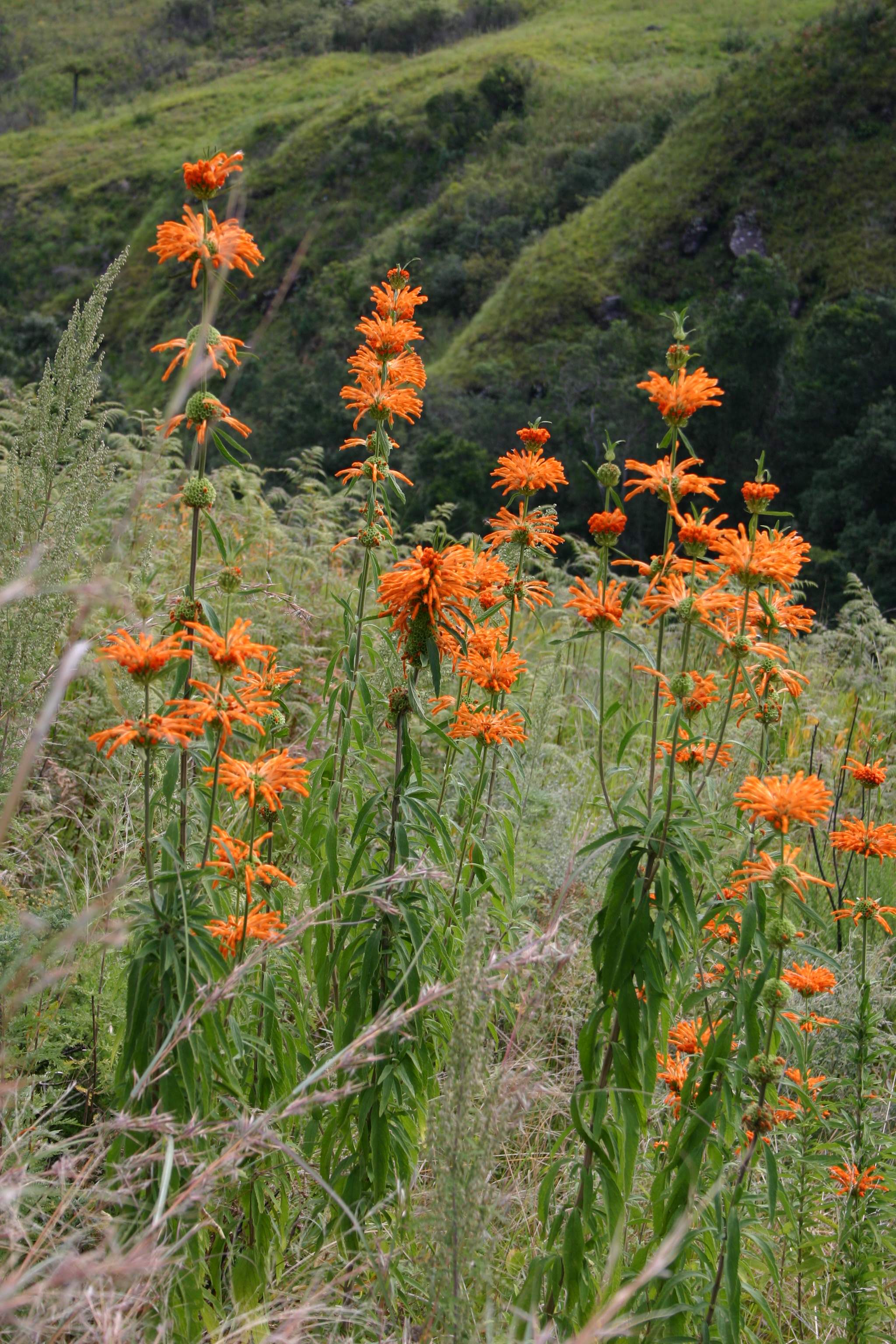
Leonotis leonurus is cultivated as an ornamental plant for its copious orange blossom spikes and is used as an accent or screen in gardens and parks. It is moderately drought tolerant, and a nectar source for birds and butterflies in landscape settings. It was introduced to Europe in the 1600s. In cooler climates it is used as an annual and winter conservatory plant.
Leonotis leonurus attracts nectivorous birds (mainly sunbirds), as well as various insects such as butterflies. The flowers' mainly orange to orange-red colour and tubular shape are indicative of its co-evolution with African sunbirds, which have curved bills suited to feeding from tubular flowers.
The medium-dark green 2-4" (5-10cm) long leaves are aromatic when crushed. The plant has tubular orange flowers in tiered whorls, typical to the mint family, that encircle the square stems. They rise above the foliage mass during the summer season, with flowering continuing into winter in warmer climates.
Type: Shrub, often grown as an annual
Hardiness zones: 6-11
Height: 36-72", 90-180cm
Location: Sun or part sun
Seeds per packet: 10
Description
Leonotis leonurus is cultivated as an ornamental plant for its copious orange blossom spikes and is used as an accent or screen in gardens and parks. It is moderately drought tolerant, and a nectar source for birds and butterflies in landscape settings. It was introduced to Europe in the 1600s. In cooler climates it is used as an annual and winter conservatory plant.
Leonotis leonurus attracts nectivorous birds (mainly sunbirds), as well as various insects such as butterflies. The flowers' mainly orange to orange-red colour and tubular shape are indicative of its co-evolution with African sunbirds, which have curved bills suited to feeding from tubular flowers.
The medium-dark green 2-4" (5-10cm) long leaves are aromatic when crushed. The plant has tubular orange flowers in tiered whorls, typical to the mint family, that encircle the square stems. They rise above the foliage mass during the summer season, with flowering continuing into winter in warmer climates.
Type: Shrub, often grown as an annual
Hardiness zones: 6-11
Height: 36-72", 90-180cm
Location: Sun or part sun
Seeds per packet: 10